

One series. Many applications.
AT Series Extraction Tables
The tables for passionate makers.
The AT series extraction tables are designed for grinding work, polishing work, deburring work, soldering work and bonding work - and fit comparable applications as well. The table is delivered fully assembled and only needs to be connected to the ducting for filter systems or fans.
Uniform and direct downdraft extraction is achieved through the table surface. For exhaust operation, the table can be connected to a fan. Combined with a stationary or mobile extraction system, the dust-laden air is filtered and can be returned to the working room.
Depending on the application, the AT series is also referred to as a grinding table with extraction, a bonding table, a soldering workstation or a work table with downdraft extraction - the operating principle (downdraft extraction across the full work surface) remains the same in all cases.
Applications
- Metal processing
- Mechanical engineering
- Industrial and trade workshops
- Training centers and schools
AT-2009 at a glance - 360 degree view of the largest model in the series.
Your benefits at a glance
Rear wall and both side walls included and quickly removable - for oversized workpieces.
Flexible suction performance through multiple integrated sliders for each suction zone.
Variable connection on the right or left - as standard via spiral-seam duct, suction hose or flange DIN 24154 series 5.
Fully removable dust drawers for easy removal of coarse debris.
Uneven floors can be leveled via the machine feet.
Suitable grid trays in plastic, galvanized steel or steel depending on application - removable without tools.
Three sizes
The AT series is available in three sizes with an identical working height of 850 mm. Industrial-grade welded sheet steel construction, painted in RAL 5011 (steel blue).
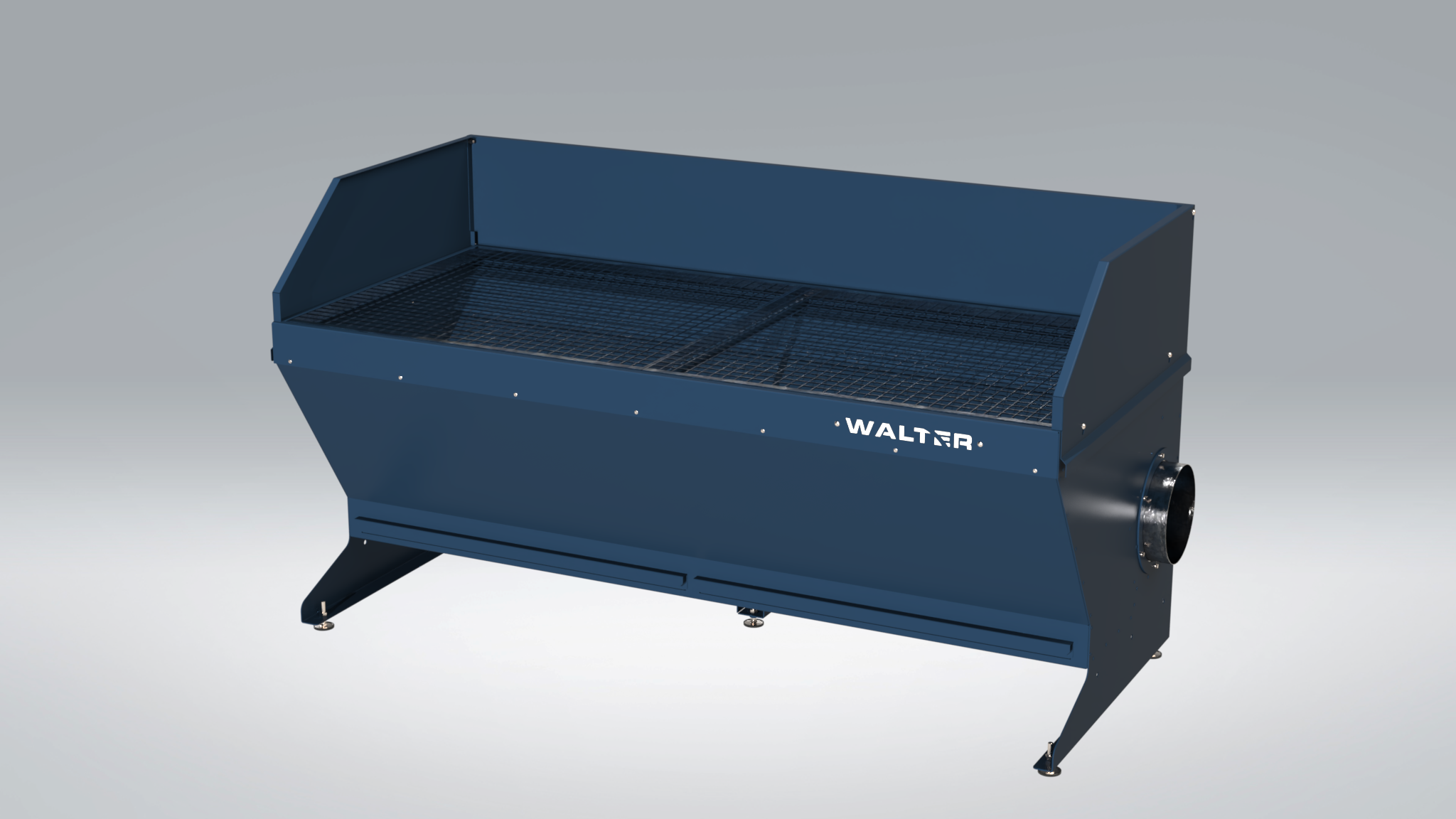
AT-2009
The large variant with 2,000 mm working width.
- Work surface
- 2,000 x 900 mm
- Suction zones
- 3
- Recommended volume flow
- 3,300 m³/h
- Connection Ø
- Ø 250 mm
- Weight
- approx. 200 kg
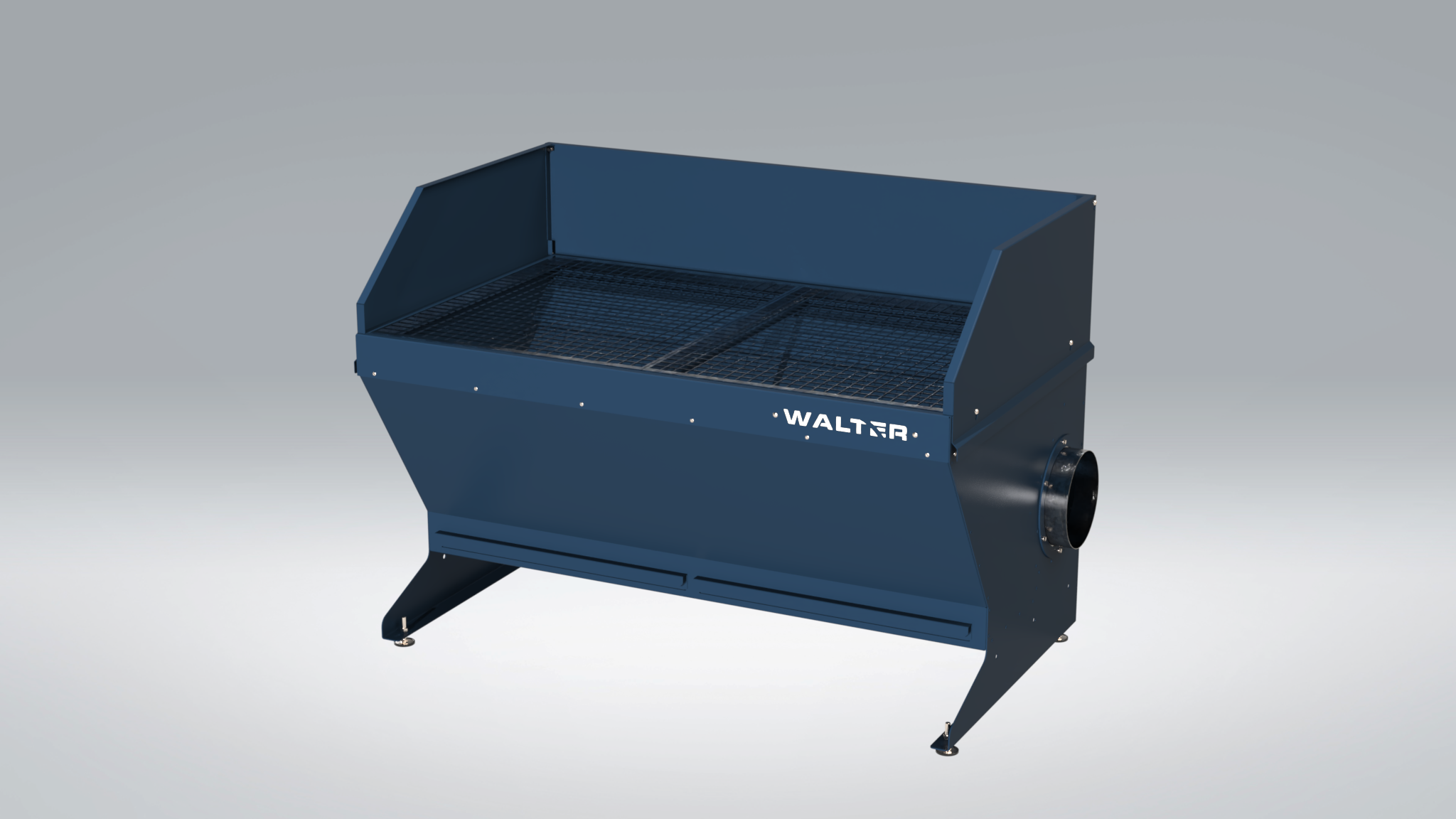
AT-1509
The mid-size variant with 1,500 mm working width.
- Work surface
- 1,500 x 900 mm
- Suction zones
- 3
- Recommended volume flow
- 2,500 m³/h
- Connection Ø
- Ø 224 mm
- Weight
- approx. 170 kg
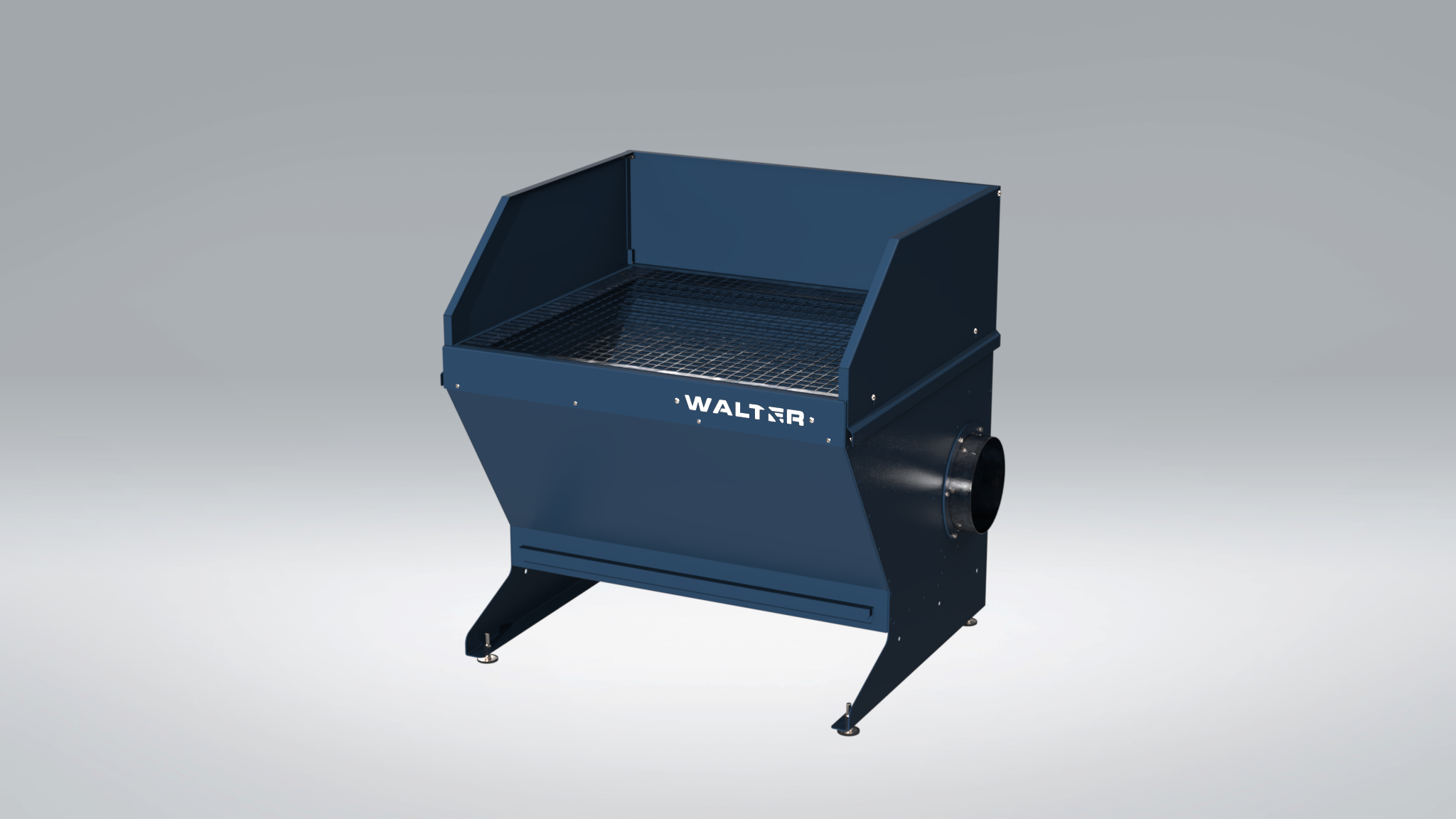
AT-1009
The compact variant with 1,000 mm working width.
- Work surface
- 1,000 x 900 mm
- Suction zones
- 2
- Recommended volume flow
- 1,700 m³/h
- Connection Ø
- Ø 180 mm
- Weight
- approx. 130 kg
Technical Data
| Type | AT-2009 | AT-1509 | AT-1009 |
|---|---|---|---|
| Work surface width | 2.000 mm | 1.500 mm | 1.000 mm |
| Work surface depth | 900 mm | 900 mm | 900 mm |
| Work surface (m²) | 1,80 m² | 1,35 m² | 0,90 m² |
| Suction zones | 3 | 3 | 2 |
| Weight | ca. 200 kg | ca. 170 kg | ca. 130 kg |
| Rec. volume flow | 3.300 m³/h | 2.500 m³/h | 1.700 m³/h |
| Connection Ø | 250 mm | 224 mm | 180 mm |
Working height: 850 mm. Static work surface load: 200 kg/m² (steel grid). Images similar. Subject to change.
Operating Principle
Dust-laden air is extracted downward through the table surface. The suction performance can be concentrated on the currently needed suction zone via the integrated sliders.
For exhaust operation without filtration, the table is connected to a fan. In combination with a stationary or mobile extraction system, the dust-laden air is filtered and can be returned to the working room.
Grid trays - available in plastic, galvanized steel or steel depending on the application - support the workpiece. Coarse debris collects in the removable dust drawers at the front and can simply be emptied.
Connection and integration
The extraction connection is available on the right or left side of the table. Three connection variants are available as standard: spiral-seam duct per DIN EN 1506, flexible suction hose, or flange per DIN 24154 series 5. The diameter matches the table size - 180 mm on the AT-1009, 224 mm on the AT-1509 and 250 mm on the AT-2009.
On the clean-gas side, the AT series can be combined with various extraction systems. For pure exhaust operation, a suitably dimensioned fan is sufficient. If filtered air is to be recirculated or emission limits need to be met, a cartridge filter (MPS series) is recommended, or a bag filter for large dust quantities. The air-flow values in the data sheet are guide values - we size the extraction system for your specific process.
The table is supplied fully assembled and painted (RAL 5011 steel blue). Only the ducting needs to be connected on site and the grid trays inserted - on-site installation by our team is available as an option.
Applications in detail
Metal processing
Grinding, deburring and polishing of steel, stainless steel and aluminum produce fine metal dusts that, without extraction, contaminate breathing air and settle on machines and workpieces. Processing stainless steel additionally introduces chromium(VI) dust, which is tightly regulated. Direct capture at source through the table surface keeps dusts out of the breathing zone.
Mechanical and plant engineering
After milling, drilling or sawing, cleaning, deburring and assembly work typically follow. The AT series serves as a central workstation for this post-processing and for soldering tasks on assemblies. The variable left- or right-side connection simplifies integration into existing production lines.
Industrial and trade workshops
In small and medium-sized operations, one extraction table covers several work steps: grinding, soldering, bonding and occasional light tack welding. The removable rear wall and side panels accommodate oversized workpieces without the need for a second workstation.
Training centers and schools
In inter-company training centers and vocational schools, several apprentices must be able to work safely in parallel. The defined suction zone at the table protects learners during basic training in metalwork, precision engineering and welding - especially important since young employees enjoy heightened occupational safety protection.
Safety and occupational health
Grinding and welding fumes are not a cosmetic issue but a health risk. The IARC has classified welding fumes as carcinogenic to humans (Group 1) since 2017. Chromium(VI) compounds from stainless steel processing and nickel in welding fumes are among the particularly regulated hazardous substances under German TRGS 528 and TRGS 905.
The most effective protection is capture directly at the point of origin - exactly what the downdraft extraction of the AT series delivers. The targeted slider configuration concentrates suction power on the currently active zone. Workplace exposure limits under TRGS 900 can be reliably undercut this way.
Whether filtered air may be returned to the working room (recirculation) or must be exhausted outside depends on dust load, dust type and the downstream filter. For carcinogenic dusts, recirculation is generally prohibited unless an official exemption is in place. We provide advice on sizing and document the filter combination used.
Optional accessories
- Grid trays (plastic, galvanized steel, steel)
- SparkBox spark arrester
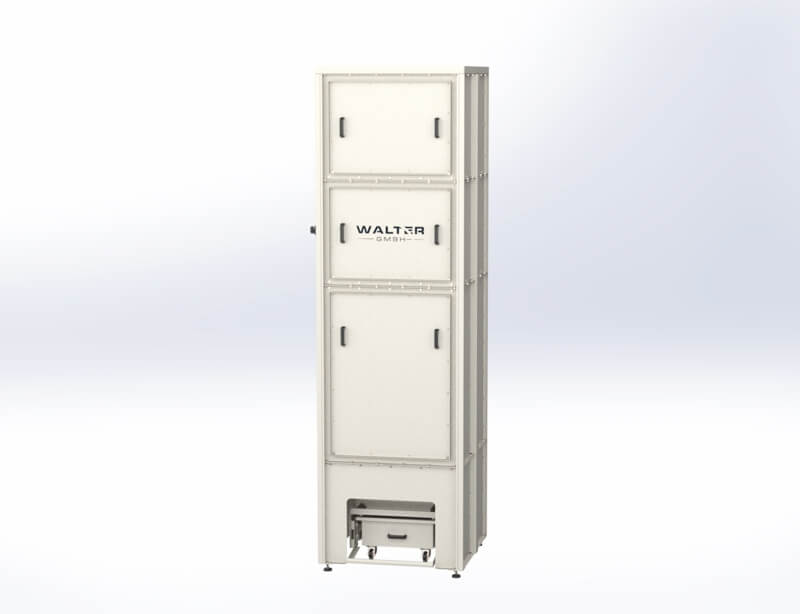
Matching extraction system
MPS cartridge filter
Modular welding fume and dust filter series that connects directly to the AT series extraction tables. Self-cleaning via compressed-air pulse jets, with integrated noise insulation hood.
View MPS cartridge filter →Frequently asked
AT series extraction tables - what customers want to know before enquiring
Is the extraction table the same as a grinding or bonding table?
Yes, depending on the application the AT series is also called a grinding table with extraction, a bonding table or a soldering workstation - the function (downdraft extraction across the full work surface) is identical in all cases. For classic welding with perforated plate surfaces we offer a separate welding table range in the WALTER shop.
Extraction table or extraction arm - which one fits when?
Extraction arms are flexible but only capture a small zone directly under the hood and must be repositioned after every work step. An extraction table captures the entire work surface from below through the table grid - ideal when work is performed at varying positions or on larger workpieces. For individual welds on very large components, the extraction arm remains the better choice.
Which extraction system fits the AT-2009?
The AT-2009 requires an extraction system with at least 3,300 m³/h at a connection diameter of 250 mm. For metal dusts and welding fumes we recommend a cartridge filter from the MPS series; for very large dust quantities, a bag filter. In pure exhaust mode, an appropriately sized radial fan is sufficient.
May filtered air be returned to the workshop?
That depends on the dust type and the clean-air quality. For harmless dusts with suitable filtration, recirculation is permitted and energy-efficient. For carcinogenic dusts - such as chromium(VI) in stainless steel welding fumes or nickel compounds - recirculation is generally prohibited under TRGS 560. We clarify this during the sizing process.
Which grid tray suits which application?
Galvanized steel grid trays are the standard for grinding and soldering. For welding with spark emission we recommend trays in non-galvanized steel, since zinc releases harmful fumes when heated. Plastic trays suit bonding work and the handling of sensitive surfaces.
Can the extraction table be used for TIG or MAG welding?
Yes, the AT series is suitable for occasional welding - particularly tack and repair welds. For intensive, continuous welding we additionally recommend a spark arrester (SparkBox) upstream of the filter and the use of non-galvanized steel trays. For predominantly welding operations, our dedicated perforated welding table is typically the more economical solution.
Would you like to learn more about Extraction Tables?
Send us your inquiry!
Your inquiry is handled personally by our engineers and technicians.
We usually respond within one working day.